Telos Alliance Telos Alliance
  • SOLUTIONS
    • TV Solutions
    • Radio Solutions
    • Media Solutions
  • APPLICATIONS
    • Audio Delays
      • 25-Seven PDM II
      • 25-Seven PDMX
    • Consoles & Audio Mixing
      • Broadcast Consoles
        • Axia Quasar Family
          • Axia Quasar XR
          • Axia Quasar SR
          • Axia Quasar Soft
          • Axia Quasar Engine
          • Axia Quasar Engine RPS
          • Axia Quasar Family Accessories
        • Axia Pulsar
        • Axia Altus
        • Axia Altus SE
        • Axia iQ Family
          • Axia iQ
          • Axia iQx
          • Axia iQ Expansion Frames
        • Axia RAQ
        • Axia Core Soft
        • Axia DESQ
        • Axia IP-Tablet Virtual Radio Software
          • IP-Tablet Core
          • IP-Tablet xNodes
          • IP-Tablet iQ Family
          • IP-Tablet StudioEngine
          • IP-Tablet VX Family
          • IP-Tablet Omnia.9
          • IP-Tablet Powerstation
      • Integrated Console Engines
        • Axia Quasar Engine
        • Axia Quasar Engine RPS
        • Axia StudioCore
        • IP-Tablet PowerStation
        • Axia QOR.16
        • IP-Tablet iQ Family
        • IP-Tablet StudioEngine
      • Accessories
        • Axia-Approved Ethernet Switches
        • Axia iPlay Network Stream Player for Windows
        • Axia iProfiler Automated Program Archiving
        • Axia iProbe IP-Audio Network Management Software
        • Axia Livewire+ AES67 IP Audio Driver
        • Axia Routing Control Panels
        • Axia Studio Control Panels
        • Axia xSelector
    • Distributed & Decentralized Routing
      • Audio Interfaces
        • Telos Alliance xNode2
          • Telos Alliance Analog xNode2
          • Telos Alliance AES/EBU xNode2
          • Telos Alliance Microphone xNode2
          • Telos Alliance Mixed Signal xNode2
          • Telos Alliance GPIO xNode2
          • IP-Tablet xNode Software
          • Omnia MPX Node
          • Telos Alliance SDI AoIP Node
        • Axia StudioEdge
        • Jünger Audio AIXpressor
      • Routing & Monitoring
        • Axia xSelector
        • XY Router Control Panel
        • Axia Pathfinder Core PRO Broadcast Controller
        • Axia Routing Control Panels
    • File-Based Audio Processing
      • Radio
        • Podcasting & On-Demand
          • OmniaTools
      • TV
        • Audio Automation for Enterprise
          • Minnetonka AudioTools Server
        • Loudness & Workflows
          • Minnetonka AudioTools FOCUS
          • Minnetonka AudioTools Carbon
    • IP Intercom & Communications
      • IP Intercom
        • Telos Infinity IP Intercom System
          • VIP Virtual Intercom Platform
          • Panels
          • Beltpacks
          • Wired Headset
          • Dashboard Enterprise Software
          • Infinity Link Software
    • Broadcast Phone Systems
      • VoIP Broadcast Phone Systems
        • Telos VX
          • Telos VX Enterprise
          • Telos VX Duo
          • Telos VXs for Radio
          • Telos VXs for TV
          • IP-Tablet VX Family
      • Broadcast Phone Systems
        • Telos Hx1 & Hx2 Digital Hybrids
        • Telos VSet Phone
    • Radio Processing
      • Radio Processors
        • Omnia XII
        • Omnia.11
        • Omnia.9
        • Omnia VOLT
        • Omnia Forza Family
        • Omnia Forza
        • Omnia Enterprise
          • Omnia Enterprise 9s
        • IP-Tablet Omnia.9
      • Audio Interfaces
        • Omnia MPX Node
        • Omnia µMPX Software
      • Microphone Processors
        • Jünger D*AP4 VAP
        • Jünger AIXpressor
    • Signal Distribution & Format Conversion
      • Audio Interfaces
        • Telos Alliance Analog xNode2
        • Telos Alliance AES/EBU xNode2
        • Telos Alliance Microphone xNode2
        • Telos Alliance Mixed Signal xNode2
        • Telos Alliance GPIO xNode2
        • Telos Alliance SDI AoIP Node
        • IP-Tablet xNode Software
        • Jünger AIXpressor
        • Omnia MPX Node
      • Axia StudioEdge
      • Livewire+ AES67
        • Axia Livewire+ AES67 IP Audio Driver
    • Site-to-Site-to-Site Connectivity
      • Codecs & Transceivers
        • Telos iPort High Density Multi-Codec Gateway
        • Telos Zephyr Connect
        • Telos Zephyr Connect SE
        • Telos Z/IP ONE
      • IP Intercom
        • Infinity Link Software
    • Stream Encoding & Processing
      • Stream Encoding & Processing
        • Telos Alliance Z/IPStream Family
        • Telos Alliance Z/IPStream R/1
        • Telos Alliance Z/IPStream X/20
        • Telos Alliance Z/IPStream R/20
        • Omnia Forza Family
        • Omnia Forza
    • Studio Essentials
      • Studio Essentials Family
      • Axia Altus SE
      • Telos VX Duo
      • Zephyr Connect SE
    • On-Air TV Audio Processing
      • Dolby Encoding, Decoding, & Transcoding
        • Linear Acousitc AERO.200
        • Linear Acoustic AERO.2400
        • Linear Acoustic AERO.8000
        • Linear Acoustic AERO.enterprise
        • Linear Acoustic LA-5291
        • Linear Acoustic LA-5300
        • Jünger D*AP8 MAP
        • Jünger D*AP8 TAP
        • Jünger AIXpressor
        • Jünger Audio flexAIserver
      • Monitoring
        • Linear Acoustic AMS
        • Linear Acoustic LA-5300
      • NextGen TV & Immersive Audio
        • Linear Acoustic AMS
        • Linear Acoustic LA-5291
        • Linear Acoustic LA-5300
        • Linear Acoustic UPMAX ISC
      • TV Loudness Control
        • Linear Acoustic AERO.20
        • Linear Acoustic AERO.200
        • Linear Acoustic AERO.2400
        • Linear Acoustic AERO.8000
        • Linear Acoustic AERO.enterprise
        • Linear Acoustic AMS
        • Linear Acoustic LA-5300
        • Jünger D*AP4 LM
        • Jünger D*AP4 FLX
        • Jünger D*AP8 FLX
        • Jünger D*AP8 MAP
        • Jünger D*AP8 TAP
        • Jünger EASY LOUDNESS AoIP
        • Jünger EASY LOUDNESS SDI
        • Jünger AIXpressor
        • Jünger Audio flexAIserver
      • Upmixing
        • Linear Acoustic UPMAX ISC
        • Linear Acoustic LA-5300
        • Linear Acoustic AERO.20
        • LInear Acoustic AERO.200
        • Linear Acoustic AERO.2400
        • Linear Acoustic AERO.8000
        • Linear Acoustic AERO.enterprise
        • Linear Acoustic AMS
        • Jünger D*AP8 MAP
        • Jünger D*AP8 TAP
        • Jünger AIXpressor
        • Jünger Audio flexAIserver
      • Watermarking
        • Linear Acoustic AERO.200
        • Linear Acoustic AERO.2400
        • Linear Acoustic AERO.8000
        • Linear Acoustic AERO.enterprise
        • Linear Acoustic LA-5300
      • Voice Processing
        • Jünger AIXpressor
        • Jünger Audio flexAIserver
    • Watermarking Monitoring & Enhancement
      • Radio Watermarking
        • Voltair II
        • 25-Seven Voltair
      • TV Watermarking
        • Linear Acoustic AERO.200
        • Linear Acoustic AERO.2400
        • Linear Acoustic AERO.8000
        • Linear Acoustic LA-5300
    • Software as a Service
      • Spotlight SaaS
    • Livewire+ Networking and Partnerships
      • Livewire+ AES67 AoIP Networking
      • Livewire Partners
        • Livewire Hardware & Software Partners
  • PRODUCTS
      Radio TV
    • Radio Processors
      • Omnia XII
      • Omnia.11
      • Omnia.9
      • Omnia VOLT
      • Omnia Forza Family
      • Omnia Forza
      • Omnia Enterprise 9s
      • Omnia.9 IP-Tablet Software
      • Omnia MPX Node
    • File-Based Audio Processing
      • OmniaTools
    • Broadcast Phone Systems
      • Telos VX Family
      • Telos VX Enterprise VoIP Phone System
      • Telos VX Duo VoIP Phone System
      • Telos VXs Virtual VoIP System for Radio
      • Telos Hx1 & Hx2 Digital Hybrids
      • Telos VSet Receiver
      • Telos VX Family IP-Tablet Software
    • Streaming Audio
      • Telos Alliance Z/IPStream Family
      • Telos Alliance Z/IPStream R/1
      • Telos Alliance Z/IPStream X/20
      • Telos Alliance Z/IPStream R/20
      • Omnia Forza Family
      • Omnia Forza
    • Software as a Service
      • Spotlight SaaS
    • Broadcast Mixing Consoles
      • Axia Quasar Family
      • Axia Quasar XR
      • Axia Quasar SR
      • Axia Quasar Engine RPS
      • Axia Quasar Soft
      • Axia Quasar Family Accessories
      • Axia Pulsar
      • Axia Altus
      • Axia Altus SE
      • Axia iQ Family
      • Axia iQx
      • Axia iQ
      • Axia iQ Expansion
      • Axia DESQ
      • Axia RAQ
      • Axia Core Soft
    • Audio Delays
      • 25-Seven Program Delay Manager II
      • 25-Seven PDMX
    • Codecs & Transceivers
      • Telos iPort High Density Multi-Codec Gateway
      • Telos Zephyr Connect
      • Telos Zephyr Connect SE
      • Telos Z/IP ONE IP Broadcast Codec
    • Watermarking
      • 25-Seven Systems Voltair
      • Voltair II
    • Mixing Console Engines
      • Axia Quasar Engine
      • Axia Quasar Engine RPS
      • Axia StudioCore
      • Axia QOR.16
    • IP Intercom
      • Infinity IP Intercom Family
      • Telos Infinity IP Intercom Panels
      • Telos Infinity IP Intercom Beltpacks
      • Telos Infinity Link IP Intercom Software
      • Telos Infinity IP Dashboard Enterprise Software
      • Telos Infinity VIP - Virtual Intercom Platform
      • Telos Infinity IP Intercom Lite Single Ear Wired Headset
    • Routers & Monitors
      • Axia xSelector
      • Axia Pathfinder Core PRO Broadcast Controller
      • XY Router Control Panel
      • Axia-Approved Ethernet Switches
      • Axia Routing Control Panels
    • Legacy Products
      • Telos Systems Legacy Products
      • Omnia Audio Legacy Products
      • Axia Audio Legacy Products
      • Telos Infinity Legacy Products
      • 25-Seven Systems Legacy Products
    • Accessories for Consoles and Audio Mixing
      • Axia IP-Tablet Virtual Radio Software
      • Axia iPlay Network Stream Player for Windows
      • Axia iProfiler Automated Program Archiving
      • Axia Livewire+AES67 IP-Audio Driver
      • Axia xSelector
      • XY Router Control Panel
      • Axia Routing Control Panels
      • Axia Studio Control Panels
      • Axia-Approved Ethernet Switches
      • Axia iProbe IP-Audio Network Management Software
    • AoIP Audio Interfaces
      • Telos Alliance Audio Interfaces Family
      • Axia StudioEdge
      • Telos Alliance Analog xNode2
      • Telos Alliance AES/EBU xNode2
      • Telos Alliance Microphone xNode2
      • Telos Alliance Mixed Signal xNode2
      • Telos Alliance GPIO xNode2
      • Omnia µMPX Software
      • Axia IP-Tablet xNodes Software
      • Jünger AIXpressor
    • Microphone Processors
      • Jünger D*AP4 VAP Voice Audio Processor
      • Jünger AIXpressor
    • Studio Essentials
      • Studio Essentials Family
      • Axia Altus SE
      • Telos VX Duo
      • Zephyr Connect SE
    • Dolby Encoders, Decoders & Transcoders
      • Linear Acoustic LA-5291 Professional Audio Encoder
      • Linear Acoustic LA-5300 Broadcast Audio Processor
      • Linear Acoustic AERO.200
      • Linear Acoustic AERO.2400
      • Linear Acoustic AERO.8000 Audio Processing Platform
      • Linear Acoustic AERO.enterprise DTV Audio Processing Software
      • Jünger D*AP8 MAP Audio Processor
      • Jünger D*AP8 TAP Audio Processor
      • Jünger flexAI Family
      • Jünger AIXpressor
      • Jünger Audio flexAIserver
    • File-Based Loudness & Workflows
      • Minnetonka AudioTools FOCUS
      • Minnetonka AudioTools Server
    • NextGen TV & Immersive Audio
      • Linear Acoustic UPMAX ISC Immersive Soundfield Controller
      • Linear Acoustic AMS Authoring & Monitoring System
      • Linear Acoustic LA-5300 Broadcast Audio Processor
      • Linear Acoustic LA-5291 Professional Audio Encoder
    • Codecs & Transceivers
      • Telos iPort High Density Multi-Codec Gateway
      • Telos Z/IP ONE IP Broadcast Codec
    • VoIP Broadcast Phone Systems
      • Telos VX Family
      • Telos VX Enterprise VoIP Phone System
      • Telos VX Duo VoIP Phone System
      • Telos VXs Virtual VoIP System for TV
      • Telos VSet Receiver
      • Telos VX Family IP-Tablet Software
    • IP Intercom
      • Infinity IP Intercom Family
      • Telos Infinity IP Intercom Panels
      • Telos Infinity IP Intercom Beltpacks
      • Telos Infinity IP Intercom Lite Single Ear Wired Headset
      • Telos Infinity Link IP Intercom Software
      • Telos Infinity IP Dashboard Enterprise Software
      • Telos Infinity VIP - Virtual Intercom Platform
    • Upmixing
      • Linear Acoustic UPMAX ISC Immersive Soundfield Controller
      • Linear Acoustic LA-5300 Broadcast Audio Processor
      • Linear Acoustic AERO.20
      • Linear Acoustic AERO.200
      • Linear Acoustic AERO.2400
      • Linear Acoustic AERO.8000 Audio Processing Platform
      • Linear Acoustic AERO.enterprise
      • Linear Acoustic AMS Authoring & Monitoring System
      • Jünger D*AP8 MAP Audio Processor
      • Jünger D*AP8 TAP Audio Processor
      • Jünger flexAI Family
      • Jünger AIXpressor
      • Jünger Audio flexAIserver
    • OEM Solutions
      • Telos Alliance OEM Solutions
      • Minnetonka Audio OEM Software
    • AoIP Audio Interfaces
      • Telos Alliance Audio Interfaces Family
      • Telos Alliance SDI AoIP Node
      • Telos Alliance Analog xNode2
      • Telos Alliance AES/EBU xNode2
      • Telos Alliance Microphone xNode2
      • Telos Alliance Mixed Signal xNode2
      • Telos Alliance GPIO xNode2
      • Omnia µMPX Software
      • Jünger AIXpressor
      • XY Router Control Panel
    • Audio Processing Monitors
      • Linear Acoustic LA-5300 Broadcast Audio Processor
      • Jünger D*AP8 MAP Audio Processor
    • Watermarking
      • Linear Acoustic AERO.200
      • Linear Acoustic AERO.2400
      • Linear Acoustic AERO.8000 Audio Processing Platform
      • Linear Acoustic AERO.enterprise
      • Linear Acoustic LA-5300 Broadcast Audio Processor
    • Legacy Products
      • Linear Acoustic Legacy Products
    • Loudness Controllers
      • Linear Acoustic AERO.20
      • Linear Acoustic AERO.200
      • Linear Acoustic AERO.2400
      • Linear Acoustic AERO.8000 Audio Processing Platform
      • Linear Acoustic AERO.enterprise
      • Linear Acoustic AMS Authoring & Monitoring System
      • Linear Acoustic LA-5300 Broadcast Audio Processor
      • Jünger D*AP4 FLX Audio Processor
      • Jünger D*AP4 LM Audio Processor
      • Jünger D*AP8 FLX Audio Processor
      • Jünger D*AP8 MAP Audio Processor
      • Jünger D*AP8 TAP Audio Processor
      • Jünger EASY LOUDNESS AoIP Audio Processor
      • Jünger EASY LOUDNESS SDI Audio Processor
      • Jünger flexAI Family
      • Jünger AIXpressor
      • Jünger Audio flexAIserver
    • Microphone Processors
      • Jünger D*AP4 VAP Voice Audio Processor
    • Broadcast Mixing Consoles
      • Axia Quasar Family
      • Axia Quasar XR
      • Axia Quasar SR
      • Axia Pulsar
    • Software as a Service
      • Spotlight SaaS
  • RESOURCES
    • Download Center
    • Case Studies
    • Blog
    • Digital Catalog
    • Legacy Products
    • Careers
  • SUPPORT
    • Support Home Page
    • Support Request
    • TelosCare
    • Warranty
    • Product Registration
    • Download Center
    • Pay Your Invoice
    • TelosHelp
  • EVENT HUB
    • Events
    • Container University
    • Webinars On-Demand
  • BUY NOW

Voltair II

  1. Home
  2. Voltair II
Voltair II
Voltair II
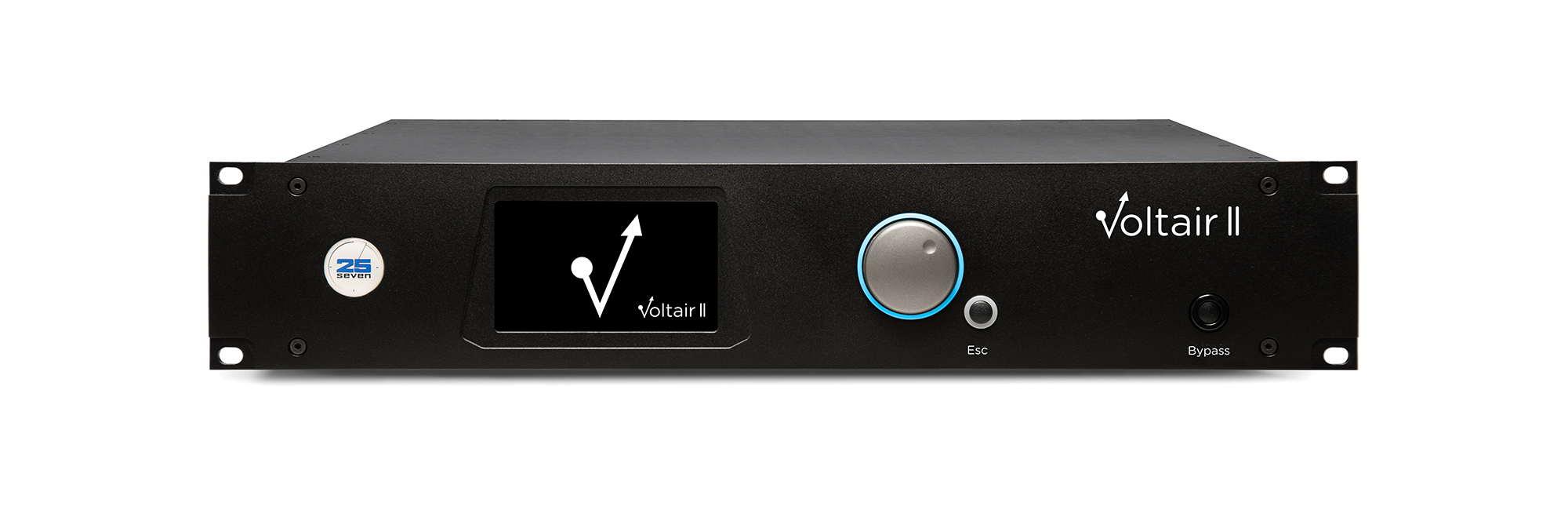
Voltair II Front
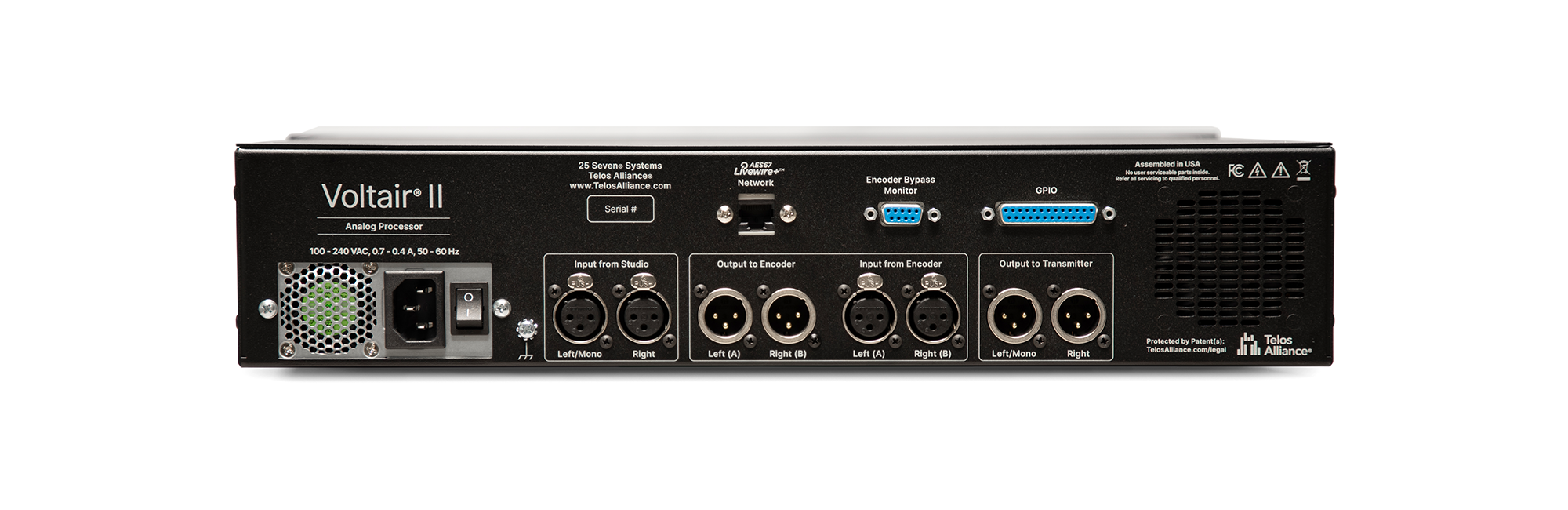
Voltair II Rear
  • Overview
  • In Depth
  • Specifications
  • FAQs
  • Buy Now

Voltair II Overview

It’s all about your listeners. Your people, your programming, your gear… they’re all focused on building and retaining your audience.

We don’t have to tell you about the direct link between the size and composition of your audience—as measured and reported by your ratings—and your advertising revenue. That’s why it’s vital to you that every panelist in your market is accurately measured and that every station is playing on a level field.

Voltair II is designed to give you even greater confidence that every listener is counted when it counts the most.

Ratings, Programming & Technical Operations

Radio ratings have been called “a game of inches,” where winners and losers are sometimes decided by the thinnest of margins. Radio management teams have always carefully monitored their markets’ listener data and taken action to maximize ratings and revenue. 

The original Voltair, launched in 2014, had a meteoric impact on our industry. It shined a light on technical realities of watermarking systems and provided new tools and fresh insights to broadcasters, empowering them to optimize their airchains for ratings success.  In 2017, the TVC-15 Broadcast Watermark Analyzer and Monitor was released, with a completely separate watermark analysis engine that could detect watermark messages off air.  While the TVC-15 could serve as an independent watermarking monitor, its “killer app” was as a connected, companion product to Voltair, providing adaptive control that automatically pushed Voltair enhancement when called for, then reduced it when not needed. 
 
Voltair II returns the functions of both the original Voltair and TVC-15 to the market in a newly combined platform. Additionally, it introduces our new “Pascal” algorithm, built to address encodability issues for the most challenging audio. In sum, the benefits of Voltair II surpass the capabilities of its predecessor, providing a competitive edge for ratings success.  

Importantly, Voltair II: 

  • Provides a 1:1 plug-in replacement for original Analog and AES Voltair units 

  • Incorporates TVC-15’s adaptive enhancement features

  • Introduces the new Pascal algorithm for the most challenging, hard to encode audio

  • Provides access to data history files at no extra charge

  • Delivers all the above in an interface that will be familiar and easily understood by any existing Voltair or TVC-15 user. 

  • In our studies, provides better ratings performance than its predecessor

Understanding The Current Ratings Ecosystem

25-Seven® has been following the deployment of watermark-based rating methodologies since they were introduced. We’ve spoken with many programmers, technologists and ratings experts  , getting their perspectives on the overall system and the results of their efforts to get the best ratings results.

After a great deal of research on watermarking technology, our team of broadcast and audio experts uncovered the variables that contribute to watermark integrity. More importantly, we developed Voltair to provide you with the tools you need to monitor and analyze these variables, providing you with data to inform your technical and programming decisions.

What did we find?

  • Audio Content—The spectral characteristics of your audio content—music, announcer voices, etc.—may negatively impact the robustness of your watermark encoding. Simply put, some audio content encodes well while other content does not.

  • Listener Environment—A listener’s device may not detect particular content because of their current acoustic environment. A song or voice may not, for example, decode as well in a car as it does in a bedroom.

  • Airchain order–placement of encoding equipment and proper gain staging makes a huge difference in watermarking success. Broadcasters who fail to pay attention in this area lose out.

To address these issues, we needed to account for the highly complex set of interactions among the encoding and decoding processes, the audio properties of content, and listeners’ acoustic environments. We developed a totally new set of easy-to-use tools for Voltair to analyze and help you manage the consequences of these interactions. Voltair II takes these tools to the next level. 

Voltair II In Depth 

How Voltair II Can Benefit You

Operating transparently in your airchain, Voltair II:

  • Monitors and analyzes the robustness of watermark encoding across all program content with two unique analysis engines.

  • Offers visibility into how noise in listening environments may influence watermark decoding.

  • Includes advanced audio signal processing to enhance the detectability of the watermark codes within the context of your programming objectives.

  • Provides “Adaptive Enhancement”: essentially an automatic gain control that pushes Voltair processing when needed, then backs off when it is not. This balances tradeoffs between getting the best possible watermarking with the best possible audio quality

  • Introduces “Pascal” - a new watermark pre-processor algorithm designed to help spoken work content encode better. 

  • Provides detailed, time-stamped Voltair processing data, exportable in a CSV format for programmers to plot against their own ratings data

  • Empowers programmers to make informed decisions to address potential weaknesses in either encoding or decoding.

For example:

  • You can use Adaptive Enhancement to set a low processing  “floor” and a high processing “ceiling” so that Voltair II can push for greater processing when content calls for it, then back off when it is overkill. 

  • You can use GPI inputs to switch between different preset configurations, adding Pascal processing when spoken tracks are playing, then reverting to a different preset configuration for music.

  • You  may choose to balance strong and weak program segments within each quarter-hour time segment to produce successful decoding and get the earned credit for the full segment.

Voltair II may also serve as an off-line tool to identify produced and live content with low encoding confidence. New programming elements—liners, promotions, etc.—may be created with greater confidence of yielding strong encoding.

Voltair II and Your Ratings

Your revenue relies on your ratings. The overriding purpose of Voltair II is to increase your confidence that those ratings accurately reflect the habits of your listeners.

As you work to get credit for all the ratings you’ve earned, keep the following in mind:

  • Even one listener device worth of data can make a measurable difference in your ratings.

  • Insights into how your audio content is handled during the watermarking process can show you ways to improve the robustness of your encoding.

  • Consideration of noise in listening environments can guide changes that may improve the reliability of watermark decoding on listener devices.

  • Adaptive Enhancement can address cases of “over-Voltairing” where stations would park the unit on a high (20+) level and leave it: a recipe for inducing encoding artifacts and possible encoder saturation.   

  • When you have confidence in the end-to-end watermark system performance of your stations’ signals, you also have more confidence in the relationship between ratings and your programming decisions.

Voltair II won’t increase your actual listenership, but it will help you be more confident that listeners to your station participating in the watermark-based ratings process are correctly measured.

Voltair II Specifications

POWER SUPPLY AC INPUT

  • Auto-ranging supply, 100VAC to 240VAC, 50 Hz to 60 Hz

  • IEC receptacle, internal fuse, on/off switch

  • Power consumption: 55 Watts

OPERATING TEMPERATURES

  • 0 degree C to +40 degree C, <90% humidity, no condensation

DIMENSIONS AND WEIGHT

  • Chassis Dimensions (ex protrusions):

    • 19” (48.2 cm) wide

    • 3.5” (8.9 cm) height

    • 11.75” (30 cm) depth

  • Chassis Weight: 14.5 lbs. (6.57 kg)

Regulatory

FCC tested and compliant, power supply is UL approved. Distribution limited to USA. No CE certification. 

What is Voltair II?

Voltair II is the new / improved successor to the original Voltair.  Voltair was in  production between 2014 and 2022, and over 1000 units were sold.  These original units remain critical infrastructure in every PPM® market in the US.

What led you to re-introduce a Voltair II after the original Voltair was discontinued? 

Driven by supply chain pressures and other resource demands, Voltair production was discontinued in 2022, while TVC-15 sales had ended in 2021.  Support and repair for both of these products has continued, but a persistent demand for replacement units and concern from broadcasters who depend on Voltair led us to re-invest in updating and improving the platform. Understand that most original Voltair units in the field are now 10 years old, some components have gone end of life, and repair times can be long.  So we chose to build a better box.    

Will Voltair II make my ratings go up?

This is important, so let’s get this straight: If you don’t have listeners, or good programming, or a signal people can receive, Voltair II (just like the original Voltair) isn’t going to help you. We only promise that Voltair II will do two things for you: It will show in real time how well (or poorly) your programming is encoding, and -- if you choose -- it will allow you to enhance your chances of getting credit for the listening that actually occurs.

Does Voltair II replace my Omnia or other audio processor?

No. Voltair is a specialized monitor / processor for watermark signals. Think of your station as having two types of listeners: ones with human ears, and the electronic “ears” belonging to panelists’ meters. Traditional processing works for the former, Voltair II for the latter.

Is there an upgrade path to turn an original Voltair into a Voltair II? 

No.  Internal systems are generations apart, and many original units are reaching the end of their service life.   For a limited time, a trade-in credit program is available.   For details, reach out to Paul Kriegler.

Didn’t Enhanced CBET (eCBET) encoding that Nielsen introduced years ago make Voltair obsolete?

No. Our client's toggle-testing proved that Voltair still makes a nice difference, and Voltair II makes an even bigger difference in all formats. Of the dozens of toggle tests we know about, here are five of our favorite examples. Mainstream AC: +8% with Voltair Soft AC: +8% with Voltair Country: +5% with Voltair Top 40: +7% with Voltair Non-comm public Radio: +9% with Voltair. Voltair II will only improve on these numbers.

Critics have said Voltair can make my audio sound harsh or cut up. Any truth to this?

Like all processors, there may be a downside to being too aggressive, especially with eCBET.   Voltair let you tune the tradeoff between watermark robustness and audibility, but how you set it was always up to you.  We have seen some stations that have just cranked Voltair to the max and walked away without really trying to optimize settings for a good listener experience, and this we consider is too aggressive.   Importantly, Voltair II integrates Adaptive Enhancement (AE) from our TVC-15 Watermark Monitor product , providing a major improvement over the first generation Voltair.

How Does Adaptive Enhancement work? 

Adaptive Enhancement uses a separate watermark analysis engine, derived from the TVC-15 unit, to control Voltair processing levels dynamically. It acts as an automatic gain controller for watermarks, pushing levels when needed, and backing off when not. Floor and ceiling levels can be set, and real time audio drives the output.  Formerly, this process required both Voltair and TVC-15 units to be paired together.  Now, Voltair II merges this “killer app” into a single box. 

What is “Pascal”? 

Pascal is an audio conditioning process designed by Frank Foti to make difficult-to-encode audio (such as dry voice) more conducive to watermarking.  It is well understood that certain types of audio, particularly dry voices and halting vocal delivery styles do not encode well.  In such cases, the PPM algorithm can not generate watermarks with sufficient energy in critical bands, and the original Voltair could not enhance what was never there in the first place.  Pascal addresses this edge case, and is incorporated exclusively in Voltair II as a pre-process before encoding.

Is there a “rule of thumb” difference between running Voltair enhancement with eCBET vs original CBET?

Extreme Voltair enhancement, at levels that might have been appropriate for conventional CBET can make eCBET even more obvious. Typically, if you were running Voltair at a setting of 20 before, you’ll want to tune it down by 10 to 12 units.

How many signals/stations can a single Voltair II handle?

Watermark codes are unique, so Voltair II, like its predecessor, pairs with one physical encoder. It can be moved to a different station with a simple recalibration. 

I have PPM Encoding running in a software SDK inside my audio processor. How do I connect Voltair II to it? 

You don’t.  Voltair II (like the original Voltair) can only work with hardware watermark encoders. PPM Software implementations and Voltair II are mutually exclusive. 

Do you ever plan to offer a software based Voltair II?

No. Voltair II relies on deterministic calibration to a hardware encoder in order to operate.  But while a software Voltair is not planned, there are secrets we have learned in the development process that have made their way to our Omnia processing to aid robust watermarking

Where can I buy Voltair II?

Voltair II, like its predecessor, is only available directly from Telos Alliance. For more information, please contact our sales manager Paul Kriegler.

How and where do I install Voltair II at my station?

Voltair II goes in your program chain, at the same point as your watermark encoder.

What have you learned about audio processing and encoding in your Voltair work?

From our research, we see great advantages in placing the Voltair II and encoder combination at the insertion points available in our Omnia 9, 11 and XII processors. Savvy programmers have been following this research with great interest and are implementing this strategy. We’ve built new “Voltair aware” presets in some of our processors.  For those planning to experiment with our new Pascal pre-encoding processor, the need for placing the unit at this insert point is even more critical.

You say that Voltair II incorporates the TVC-15 monitor.  Can it do everything the TVC-15 could do?

Not everything. The standalone TVC-15 unit could decode and identify multiple encoders off the air.  Since its use inside Voltair II is to serve the single encoder it is paired to, it no longer has these generalized features.  In our view, TVC-15’s analysis engine and the Adaptive Enhancement feature it powers is its most important feature.

Can competitors or Nielsen tell if I’m using Voltair II?

No more so than the original Voltair.  By design, Voltair II leaves no fingerprints, as most audio processors don’t. In fact, with Adaptive Enhancement in Voltair II, we expect those who know what to listen for will hear watermark artifacts less. 

What kind of results are customers seeing?

Believe it or not, our customers don’t talk much about which audio processors they use. They treat that intel as a state secret. We respect this and always have. Anecdotally, we can report that Voltair II field tests showed a modest increase over the original Voltair.

Voltair had data export capabilities, but you had to pay a license fee for them. How about with Voltair II?

We’ve made the data export capability in Voltair II a standard, free feature. 

Is Voltair and Voltair II unfair? Doesn’t it create a world of haves and have-nots?

No. Some stations have the latest Omnia processors, while some are stuck with older Optimods® or others. Some stations have high-priced morning talent, and some don’t. Some stations have 100,000 watts, and some have only 250 watts.

What led you to build Voltair, then to improve it with Voltair II?

True confession: We’re broadcasters and we love Radio. We push the envelope. We invent things to make broadcasting better. Voltair has its place alongside other Telos Alliance inventions, like the Telos 10 (the digital on-air phone system that revolutionized talk radio), the Zephyr (the first use of ISDN in a broadcast product that forever changed remote broadcasting), the Omnia 11 (radio’s first FM audio processor with multipath reduction and a digital connection to exciters) and Axia, the world’s first audio consoles using Audio over IP (AoIP). Voltair II carries on that tradition of innovation.

Why are Voltair and Voltair II good for Radio?

Our clients tell us that they see increases in all 3 key measurement metrics since Voltair came on the scene. Cume, TSL and AQH appear to be growing in every PPM market. This is significant. It speaks to a rising tide that lifts the radio broadcast boat. More accurate measurement is in the industry’s best interest and means more advertising dollars flowing back to Radio. Voltair II improves on its predecessor when the industry needs it most. 

Resources

Contact Sales
  • Contact Sales about Voltair II

TelosHelp
  • TelosHelp Homepage

Voltair II
FREE / DISCOUNTED REMOTE SERVICE

FREE / DISCOUNTED REMOTE SERVICE

The first 60 minutes of Remote Assistance free, with 50% discount thereafter. *applies to a daily per incident/issue

UPDATES & UPGRADES

UPDATES & UPGRADES

Always be up to date on the most current release.

SERVICE & SUPPORT FOR PROFESSIONAL BROADCASTERS

SERVICE & SUPPORT FOR PROFESSIONAL BROADCASTERS

Preserves your investment and offers total peace of mind.

FREE REPAIRS

FREE REPAIRS

Choose from a free priority repair at factory or advance swap of product.

UNLIMITED PRIORITY CUSTOMER SUPPORT

UNLIMITED PRIORITY CUSTOMER SUPPORT

Round-the-clock access with guaranteed response under four hours, every day.

Related Products

25-Seven Voltair Watermark Monitor & Processor25-Seven Voltair Watermark Monitor & Processor

25-Seven Voltair Watermark Monitor & Processor

Voltair M Legacy

Voltair M Legacy

25-Seven TVC-15 Watermark Analyzer & Monitor25-Seven TVC-15 Watermark Analyzer & Monitor

25-Seven TVC-15 Watermark Analyzer & Monitor

Telos Alliance

About Telos

  • About Telos Alliance
  • About Livewire+
  • Careers
  • Partners
  • Privacy Policy
  • Terms of Use

Contact

  • Contact Us
  • Customer Support
  • Press Room

Shop

  • Purchase
  • Find a Dealer

Knowledge

  • TelosHelp
  • Catalog
  • Newsletter
  • Container University
© 2025 Telos Alliance