

Minnetonka AudioTools SERVER Overview
Quality-First Audio Automation
Minnetonka Audio® AudioTools® Server automates a comprehensive range of file-based audio processing tasks, from routine level adjustments to intricate multi-program delivery profiles. It is ideally suited for linear broadcast platforms like cable, satellite and terrestrial, modern digital networks including OTT, IPTV and radio, and commercial post-production facilities. Built as a pure software platform, it runs seamlessly on commodity hardware, virtualized systems, or cloud deployments such as Amazon AWS.
By consolidating loudness regulation, codec management, automated mixing and quality control into flexible, automated workflows, AudioTools Server gives enterprise operations the agility to scale dynamically. This integrated approach dramatically reduces operational overhead while ensuring absolute compliance and uncompromised audio quality.
-
State-of-the-Art Processing: Transparent audio processing and loudness control across broadcast and streaming platforms.
-
AI/ML-Driven Modules: Next Generation Audio processing, including language detection, dialog intelligibility, and AudioShake® source separation
-
Compliance Made Simple: Industry-leading loudness measurement and correction built to meet international broadcast standards and accessibility targets.
-
Enterprise-Grade Automation: Runs invisibly in the background via Windows Services and is designed for unattended operation
-
Industry Standard: Trusted by major broadcasters, post-production houses and streaming platforms globally.
Enterprise Integration & Scalability
Driven by highly customizable XML profiles, AudioTools Server features a modern REST API to easily connect with industry-standard Workflow Automation and Media Asset Management (MAM) ecosystems. From small post-houses processing a handful of files per week, to enterprise facilities scaling across cloud instances with floating licenses, its architecture grows perfectly with your operation.
Some of our Strategic Partners

Minnetonka AudioTools SERVER Features
Your Complete Audio Toolbox
AudioTools Server features a comprehensive range of audio processing options. Its modular architecture keeps your toolset current and unlocks powerful workflow design. Facilities can build sequential or highly conditional profiles that combine these modules to match their exact deliverable requirements in a single pass.
-
Loudness Control & Compliance: State-of-the-art loudness control based on international standards and practices. Advanced Loudness Adaptation workflows ensure compliance and improved dialog intelligibility, specifically tailored for high-dynamic-range (HDR) content.
-
Immersive & Next-Gen Audio: Automate Dolby® Atmos encoding and MPEG-H pre-processing, with upmixing capabilities up to 9.1.6 channels.
AI/ML-Driven Processing: Leverage AI modules for language detection, dialog intelligibility and AudioShake® source separation. -
Codecs & File Handling: Manage all major audio codecs, including Dolby E, Dolby Digital Plus, MP2, MP3 and AAC, with support for encoding, decoding and transcoding. Extract and rewrap audio essences from video containers such as MXF, QuickTime and MPEG Transport Streams, with channel management tools for manipulating the layout of the final output files.
-
Automation & Editorial Utilities: Streamline workflows with auto-mix/auto-ducking features for voiceovers and audio descriptions. Perform essential editorial tasks such as upmixing, downmixing, time stretching, pitch shifting, and segment trimming and stitching.
-
Quality Control: Audio-specific QC, including channel assignment detection, silence detection, phase analysis and correlation checks.
Radio Processing: Omnia® Forza and Omnia.9 radio-style processing makes on-demand podcasts sound like polished broadcasts.
 For a detailed explanation of all available processing modules, please expand the “Brochures” section in the right side menu, and click on “AudioTools Server Module Specifications.”
Minnetonka AudioTools SERVER In Depth
The AudioTools Workflow Engine
At its foundational layer, AudioTools Server is driven by a highly customizable XML-scripted architecture. Every input and output parameter, processing step, results analysis and logic test is translated into a structured XML workflow.
This code-first approach allows the application to be highly customizable, offering infinite flexibility. It also provides seamless integration with enterprise workflow-orchestration tools via the AudioTools REST API, enabling external systems to dynamically manipulate specific workflow parameters inside the XML just prior to submission, and effortlessly pull detailed results, compliance metrics and logging back from the workflow on completion.
AudioTools WorkflowCreator: Bridging Design and Code
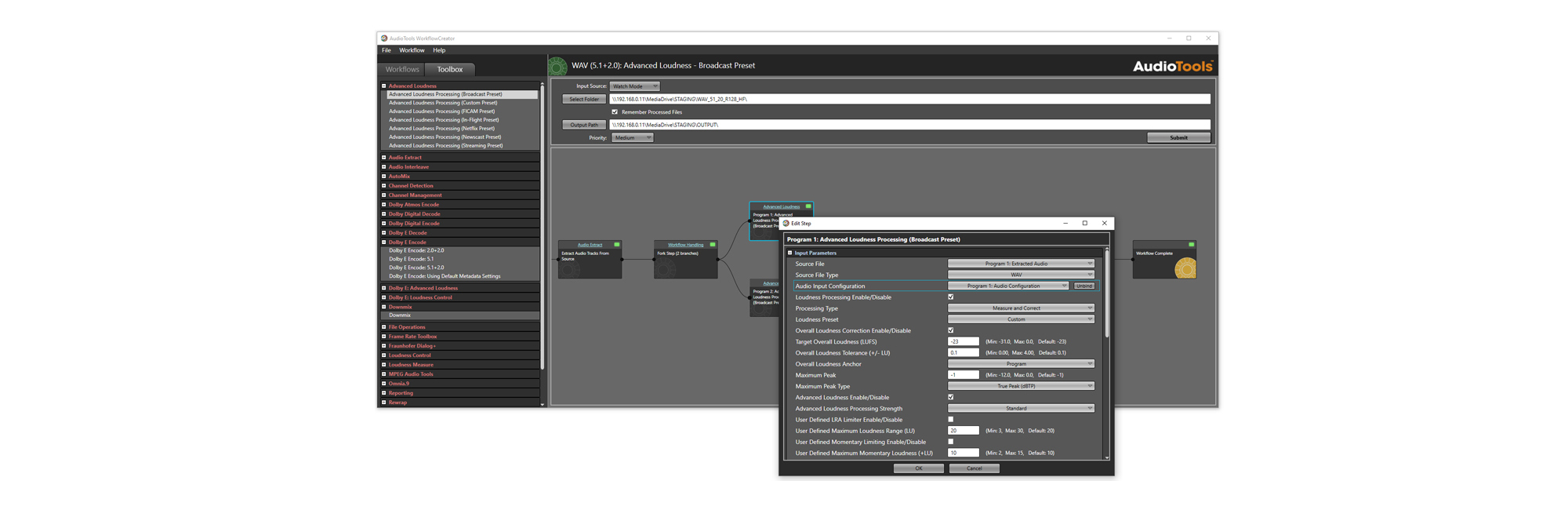
AudioTools WorkflowCreator bridges the gap between raw code and intuitive operational design, allowing anyone to wield the full power and sophistication of AudioTools Server via an easy-to-use graphical user interface.
-
Building Made Simple: New workflows can be easily created simply by dragging and dropping steps onto the workflow canvas from the comprehensive module toolbox - no need to touch the underlying XML code. Modifying workflows is also simple, making it possible to add, delete, or rename steps in just a few clicks.
-
Advanced Parameter Management: Each step comes with its own set of controllable parameters that can be adjusted to meet requirements. Individual parameters can also be bound to upstream (customizable) references, or can be copied en masse between steps.
-
Powerful Workflows Need Powerful Tools: Fork processing into parallel branches to maximize efficiency, or use Logic Steps to drive decision-making based on preceding results. Easily derive new workflow parameters through calculations and conditional tests. Plus custom reporting, email notifications, file management and more - all possible with just a few clicks.
-
1000+ Pre-Configured Templates: Get started quickly using the extensive, searchable library of workflow templates. Each template is fully editable, so it can be tailored to your exact requirements in minutes.
-
Flexible Submission Options: Files and watch folders can be submitted to the server for processing directly from the WorkflowCreator interface, or workflows can be exported for submission via third-party tools, such as Telestream Vantage, or web services integration.
AudioTools Operator: Simplified Control
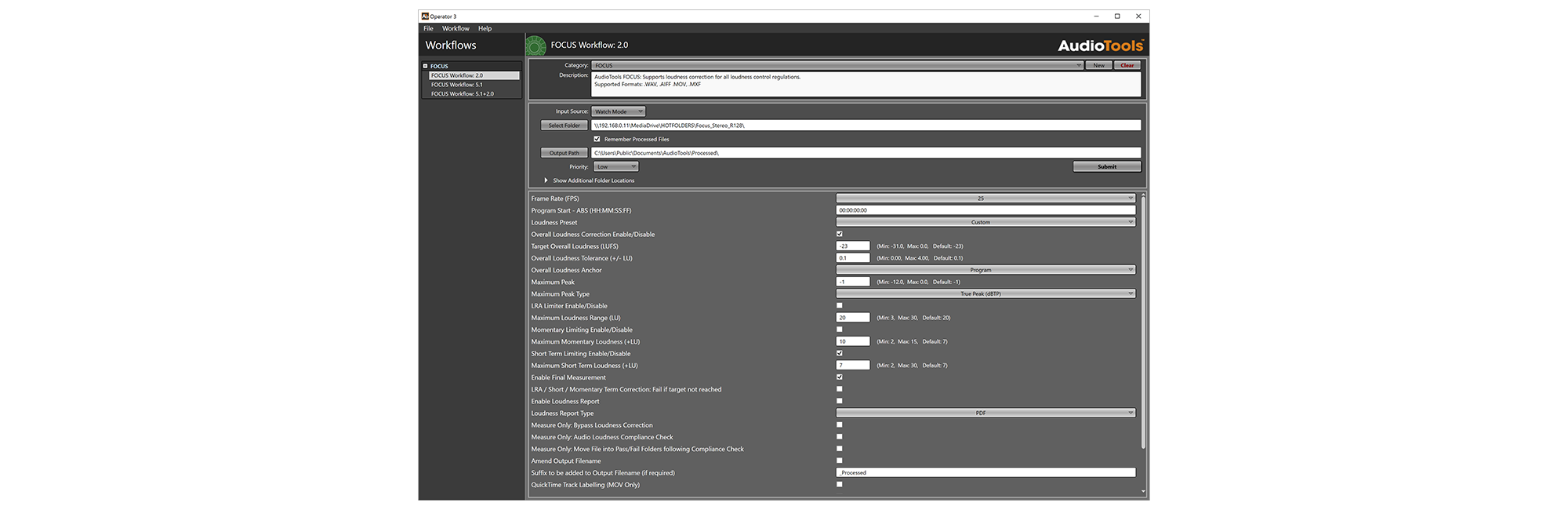
For simple manual operations, the AudioTools Operator application offers a streamlined interface that handles file submission and parameter adjustment from a single, easily digestible page. Its intuitive design allows non-technical staff, tape-room technicians, or editors to easily adjust any targets, such as loudness settings or Dolby metadata, prior to submitting a job. Administrators can completely customize which specific parameters are visible, or even engage a “Read-Only” mode to ensure regular users never overwrite standardized facility settings.
Once targets are set, users can process media immediately using manual File Mode or activate a live Watch Folder that automatically triggers processing as new assets arrive. Users can also export profiles directly to the Job Queue WebUI to launch jobs remotely from any network browser. This combination of hands-on simplicity and automated flexibility makes AudioTools Operator the primary control interface for the AudioTools FOCUS product family.
Monitoring Tools
Queue Control
Queue Control is a versatile desktop client application that serves as the central command and control hub for the AudioTools Server system. As a queue monitoring tool, it allows users to track the status of any submitted jobs, offering direct access to detailed results information and troubleshooting logs. Queue Control also acts as the primary interface for managing the system's underlying architecture, allowing administrators to configure local node settings, as well as link remote nodes for specialized roles such as license sharing and load-balancing.
Job Queue WebUI
With a completely redesigned interface for AudioTools Server Version 7, the AudioTools Job Queue WebUI brings the platform's browser-based client into visual alignment with the clean, unified look of the wider Telos Alliance® ecosystem. Its lightweight dashboard allows operators to track the state of running processes, view measurement results and access detailed logging from any network-connected browser or mobile device without requiring administrator access. The WebUI also serves as a flexible remote workspace where authorized users can submit new workflows or stop executing processes, with a password-protected administrative area available for managing advanced local controls.
REST API Monitoring
In addition to the built-in tools, the AudioTools REST API provides a comprehensive toolset of controls that allows users to implement their own customized queue monitoring tools or seamlessly integrate tracking directly into a facility's pre-existing asset management software.
Minnetonka AudioTools SERVER System Requirements
The overall performance of an AudioTools Server processing node depends on several factors. Some processes rely more heavily upon CPU resources, and others are more dependent on network/storage speed. To get the best performance, AudioTools Server relies on a combination of a fast network storage connection, high CPU clock speeds, and fast local storage for scratch and temporary files. See below for details.
Operating System
Recommended Operating Systems:
-
Microsoft Windows Server 2016
-
Microsoft Windows Server 2019
-
Microsoft Windows Server 2022
-
Microsoft Windows Server 2025
-
Microsoft Windows 10 Pro
-
Microsoft Windows 11 Pro
Note: We recommend using Windows Server 2022 (or Windows 11 Pro) as the minimum operating system for any new installation.
These operating system requirements apply to all supported deployment methods: Physical server, virtual machines as in VMWare and HyperV, or cloud deployments as in Amazon AWS.
CPU
-
Architecture: x86-64 (64-bit), required for OS.
Note: The application itself is a 32-bit (x86) process; CPU selection can prioritize higher clock speeds and core counts over large L3 caches or multi-socket scalability.
-
Minimum: 8 cores at 3.5 GHz (modern CPUs)
-
Recommended: 16 cores at 4 GHz or higher;
Note: The number of cores should be proportionate to the number of simultaneous processes expected. E.g. 8 cores for 4 jobs, 16 cores for 10 jobs etc.
Example Models:
Minimum:
- Intel® Core™ i5 (13400/14400 or newer)
- AMD Ryzen™ 7 (5700X/7700 or newer)
Recommended (High Throughput):
- Intel® Core™ i7 (13700/14700 or newer)
- AMD Ryzen™ 9 (7900 or newer)
Note: Comparable recent server-class CPUs (Xeon, EPYC) are also supported.
Memory
- Minimum: 16GB RAM
- Recommended: 24-32GB RAM
For processing large media files (e.g., QuickTime, MXF) or in high concurrency workloads, more RAM will improve reliability and performance.
Network Storage
When media files are processed directly from shared network storage (e.g. NAS or SAN):
- Bandwidth: A dedicated high-speed connection is required - ideally 10GbE (10 Gigabit Ethernet) or faster for NAS, or a direct Fibre Channel connection for SANs.
Where a high-speed connection to fast, shared storage is not available, consider copying the source media files to the AudioTools Server node and processing them locally.
Local Storage
AudioTools Server creates temporary files during processing. To minimize network traffic and maximize throughput, we recommend configuring local "scratch" space:
- Drive Type: A high-speed SATA SSD or NVMe M.2 SSD is highly recommended.
Note: Modern solid-state drives (SSDs) have replaced the need for complex, multi-disk hardware RAID 0 arrays while providing superior read/write speeds.
- Capacity: Must comfortably hold the combined size of source files plus generated temporary files for the expected concurrent workload.
Amazon AWS machine instance requirements
For Amazon AWS deployments, the recommended EC2 instance type depends on the role of the node and the expected workload
Worker nodes:
- For typical audio processing workloads, a compute-optimized C-series 2xlarge or 4xlarge EC2 instance, or comparable newer equivalent, is recommended at minimum.
- For workloads involving larger media files or higher memory and storage demands, a general-purpose M-series 2xlarge or 4xlarge EC2 instance, or comparable newer equivalent, may be more appropriate.
LicenseServer or load-balancing-only nodes: These nodes typically require fewer resources and can generally use a general-purpose M-series large EC2 instance, or comparable newer equivalent.
Storage: Storage selection should reflect the workload:
- Use EBS-backed storage where persistent storage is required.
- Use local NVMe SSD / instance store for high-speed temporary or scratch storage where persistence is not required.
- Ensure sufficient storage throughput and capacity for the expected number of concurrent jobs and temporary file generation.
Equivalent or newer EC2 instance types with similar CPU, memory, network, and storage performance are also suitable.